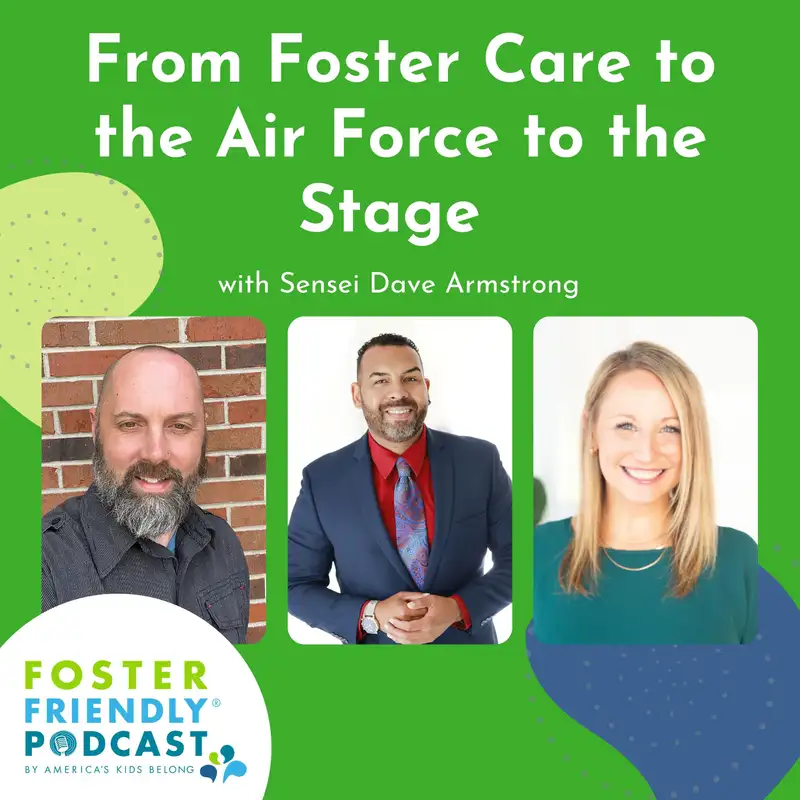
Travis (00:01.03)
Hey, welcome to another episode of the Foster Friendly Podcast. My name is Travis Vongznus, and I'm joined by my co-host Kristen Allender. We are excited today to kick off our aging out series. And we're gonna have probably three or four episodes featuring former foster youth who have aged out of the foster care system. And then we're gonna kind of unpack some of their journey and stories, share insights that they've gained through their time, and then talk about what they're doing now and and maybe this advocacy work or where that's led them. So
Gonna be what we're gonna be doing. And today we are very excited to have on Sensei Dave Armstrong, who is a resilient speaker, an at-risk youth advocate, an author, mentor, and retired U.S. Air Force veteran. He grew up in foster care, spent time in juvenile detention, became homeless at 18, served 24 years in the Air Force, and later rebuilt his life after facing cancer and other obstacles later in life.
Kristin Allender (00:36.277)
You
Travis (00:57.498)
Sensei Dave, it is awesome to have you on the podcast. Before we go any further, describe your title or Sensei, what that that kind of means.
Sensei Dave Armstrong (01:05.388)
Yeah, so you know, part of it is the fact that I used to own martial arts schools. So I started in martial arts. Actually part of my foster care journey. And what changed me has to do with my first martial arts instructor. And then as I built the business and built the speaking career, I hired a mentor and he said, you know, we gotta differentiate you from everyone else. So when they type in something, they gotta be like
They can't Dave Armstrong. There's a million Dave Armstrong. When you type in Sensei Dave Armstrong, boom, I'm on the front front pages. So he great great guy, great branding, smart person. So so I stuck with it ever since.
Travis (01:35.322)
You're right.
Kristin Allender (01:40.179)
Nice.
Kristin Allender (01:43.615)
You
Travis (01:46.726)
Love it. That's awesome. Okay. So before we get more into your story and kind of your journey, what you live currently in Greece. So I want to hear what is the best part of living in Greece and what do you most missed about living in the US?
Sensei Dave Armstrong (01:48.195)
Thank you.
Sensei Dave Armstrong (01:53.825)
I do.
Sensei Dave Armstrong (02:00.587)
that's a great question, Travis. So look, I I came to Greece back in twenty seventeen because I fell in love with the culture, with the food, with the people. I was stationed here working for NATO for two and a half years and just was like, this is it. This is living, this is what I should be doing right here. And so I came and I did it. I've been here for nine years and you know, the recently I just decided that I'm moving.
And and it's because of the the connection, the ability to, you know, just show up in people's spaces. You're you're you're dislocated from the United States and you know, foster care, juvenile justice isn't a huge problem in most other countries as it is in the United States. And that's because of the family systems that a lot of different countries have. So
Travis (02:54.428)
Sense.
Kristin Allender (02:54.601)
Mm-hmm.
Sensei Dave Armstrong (02:55.301)
I I'm moving back to have more impact and and that's the that's the one I don't want to say negative, but that's the one challenge is is being able to to have that community, to have those connections, to interact with people that are akin to your mindset and doing some good things.
Travis (03:15.506)
Cool, that makes a of sense. Yeah.
Kristin Allender (03:15.909)
Well, give us the beautiful answer. Great. give us a food. What food or what can you get in the US that you just haven't been able to get in Greece?
Sensei Dave Armstrong (03:23.273)
In the nothing. Nothing at all. I don't miss the food in the United States. No, not at all. And when I miss this is this is so pretentious. And and when I miss Italian pizza, I just fly over to Italy. It is. okay. No no. There's a couple of barbecue spots that are really good here, but not like in the States, not like you know, so down south, something like that.
Kristin Allender (03:25.149)
Okay, okay, nice.
Travis (03:25.498)
Nothing. Nothing.
man.
Kristin Allender (03:30.441)
Fair.
Travis (03:38.096)
But you gotta th Barbecue though? Come on barbecue, I mean a good burger? I mean come on, there's gotta be
Kristin Allender (03:38.941)
But you have, it's easier, yeah.
Travis (03:47.673)
Okay.
Kristin Allender (03:52.789)
Mm-hmm.
Travis (03:52.85)
Sure, taxis. Mm.
Sensei Dave Armstrong (03:53.25)
But I'm a health freak, you know, I I I cook most of my my meals anyways. Like I I don't tend to eat out. so yeah. I mean look, Greece is known for food, right? You don't you don't get better. I've lived in a lot of places, different countries, and you you don't get better than Greece. I'm gonna miss the food. Yeah.
Travis (04:09.274)
Yeah.
Kristin Allender (04:12.565)
some solid food there. I bet, I bet. All right, all right, Sensei Dave, take us into your story leading up to and beginning in foster care.
Sensei Dave Armstrong (04:26.015)
Wow. So it started when my my mom married my stepfather. And I was about nine, ten years old, something like that.
And you I could recall that she and I had a good relationship. It didn't seem like it was tenuous or strained or anything. It seemed like it was a good relationship as as I was growing up. I remember her tickling me. I remember us playing, you know. And then then she married this guy, my stepfather, and things changed. And I think that's a story that that a lot of people can relate to. Something happens and then it everything just kind of falls apart from there. And it fell apart.
Travis (05:07.194)
Mm.
Sensei Dave Armstrong (05:08.473)
And because he was beating her, because he was beating me, it was just a a horrible environment at home, I started running the streets. And a lot of kids that joined gangs have the same exact story. You know, I what was at home?
You know, why would I stay at home watching my mom get beat or getting beat by by my stepdad? That makes no sense. So you start running the streets, you you start getting into to trouble, running with the wrong crowd, and that's exactly what happened. And then I ended up getting arrested for felony arm robbery.
Travis (05:42.448)
Yeah.
Sensei Dave Armstrong (05:42.612)
when I was eleven and a half years old. So that was my first touch with the system, not the foster care system, the juvenile justice system. And so I get arrested, get sentenced to two years in a boys' camp. And then during the two years that I'm there, my mom passes away. She has a brain aneurysm. And I had no other family. And so I I I had family in Puerto Rico or have, but I didn't know, you know, where they were, who they're here's this eleven and a half year old kid. What do you know about traveling and you know address?
And things, you know? And so that was it. I I was just a a ward of the state, and and that started my foster care journey, in and out of juvenile detention centers, foster homes, group homes, and just again and again and again. And
Travis (06:30.65)
Mm.
Sensei Dave Armstrong (06:32.813)
it ended up aging out of the system when I was eighteen and becoming homeless, like a lot of youth, even now, but especially back then. I'm fifty two now, so we're talking eighties and and early nineties.
Travis (06:48.337)
Yeah.
Kristin Allender (06:49.589)
Do you have any idea how many homes you were in throughout that time? Any foster homes?
Sensei Dave Armstrong (06:52.845)
Dozens. No, dozens. I don't know because I I was I was incorrigible. I I was a real I don't want to say bad, but I was a bad kid. And I fought a lot. I I did a lot, you know, stole a lot, robbed a lot, you know, stealing cars, robbing people. So I i it was it was th this is something it I wanted one of my talking points today I wanted to get into is is having a consistent caring adult and and
Travis (06:54.726)
Thousand. Mm.
Kristin Allender (06:58.921)
Mm-hmm.
Travis (07:09.627)
Yeah.
Travis (07:21.074)
Hm.
Sensei Dave Armstrong (07:22.701)
You know, I don't get to write my kids off. My my my daughter's 31 and my son's 32. And no matter what they have done, and and they have done some stuff throughout the years, or or what they do in the future, I don't get to write them off, right? I don't get to go, whatever, I I don't care. and
Unfortunately, the state doesn't have that mentality, and a lot of times our youth don't see, our youth in the system don't see even one caring adult that's consistent, right? That just says, Yeah, you know what, you rob you robbed that lady, but it's okay, we're gonna get through it. Right? And and so just showing up, just showing up and being consistent and and going.
You know, pick a kid. Pick one kid. You know, you don't have to pick 12 kids or seven kids or whatever. Just pick one kid and go for life.
Travis (08:23.57)
Hmm. Yeah. Well, I know a little bit of your story, and as we kind of transition to the back side of foster care where you age out, transition out, it sounds like there was someone, and maybe this person came out later, but it sounds like there was a pivot point for you of some adult, a guy that really saw you, made you feel belonging. Was that in foster care or right after? Tell us more about that and then exiting foster care.
Sensei Dave Armstrong (08:50.731)
Yeah, it it w there I had two. I got very lucky. I got very lucky. you know, aging out shouldn't mean aging alone, right? And I what I didn't age out alone. I had Sensei Otto who was my first martial arts instructor.
Who was a therapist at one of the group homes, one of the boys' homes that I was at. And then I had my CASA, Ron Barnick, and he was a pilot in the Air Force. And so you see that both of them inspired me to join the Air Force and serve twenty-four years and open up martial arts schools where I've been able to mentor and help thousands of people.
And because of both of them, I've been able to do advocacy work and start a nonprofit and have the heart to go, I know where these caring adults are coming from, and and I know where the youth are coming from. I have a very unique perspective because I've been on both ends of the spectrum, which if if it weren't for both of them, I wouldn't have I wouldn't have been able to do that.
Kristin Allender (09:57.77)
That's so great. Sorry.
That just reminded me, sensitive, you know that we film kids, right, who are in need of a forever family and often we'll do those interviews and I'll be sitting across from a kid at the end of the day and I can tell by their answers to some questions which adult they hung out with throughout the day, like who was paired up with them as their buddy, because they say things like, I want to be an artist manager. And I go, I'm like, that person was with Steve all day. You know, that's what he does. And that was just one moment, you one day, a few hours they spent with that kid, but.
Sensei Dave Armstrong (10:06.305)
Yeah.
Kristin Allender (10:29.449)
but they made an impact and suddenly they're thinking this is a career pathway. And so how cool that the two adults that impacted you so much obviously had a very significant impact on the trajectory of choices and decisions you made. That's really, really cool. I hope those kids that wanted to be artist managers get to be artist managers someday then. I'm like thinking of them, yeah. Right, right.
Travis (10:31.986)
Hmm.
Sensei Dave Armstrong (10:42.571)
Yeah.
Yeah.
Sensei Dave Armstrong (10:48.961)
Ha ha.
Travis (10:50.192)
You never know. Yeah. Man. I one thing I was just curious on is in light of the military, there's an interesting thing where I just read about this where the rate of enlistment from kids who've come from the foster care system to the military system recruitment is like two to three times the general population. And it kind it's pretty staggering. and so one can kind of see
What what are your thoughts around maybe just from all the mentoring and times you've seen kids or your own story of like, what is it maybe that the military sort of provides as a new system leaving the foster system? Like, do you have any thoughts on that?
Sensei Dave Armstrong (11:32.802)
Yeah. Yeah, I have a million thoughts on that. I could I could give you a million reasons. So for one, it it's the only place we have to go. I I didn't have
Kristin Allender (11:36.213)
Mm.
Sensei Dave Armstrong (11:48.15)
s of an aunt, an uncle, the somebody to rely on. You know, I was lucky to be able to have a girlfriend when I when I aged out and was homeless that her parents let me sleep in a trailer in the back of their field. Right? I was lucky. but there was no electricity, there were rats, there were roaches, you know, it was bad, but at least it was
kind of a roof over my head, but the military it gave me a place to sleep. You know that's that you know, I don't know if you know Maslow's hierarchy of needs, but you know, the bottom tier is is safety and security. And if you don't feel safe, if you're not secure, then you can't thrive. Cannot, period. Period. And so it it gave me a place to lay my head.
Travis (12:22.268)
Yeah.
Sensei Dave Armstrong (12:41.349)
that that's safe. And and then talk about discipline. Most of us in the system lack discipline. Not our fault. We're taught discipline. Nobody nobody's born innately disciplined, right? And so of course we lack discipline. We've been uprooted 10 times. We've been abandoned a hundred times. We've been lied to a hundred times.
Kristin Allender (12:59.881)
Mm-hmm.
Sensei Dave Armstrong (13:07.531)
Right. So why w where who do we mirror discipline from? Right? And so the military, a lot of youth that have been touched by the system go in and go, Wow, this is what it feels like to be accountable. Right? Young people don't need us to lower the bar, they need us to build a stronger bridge so they can reach it. And that's what the military did.
Kristin Allender (13:25.321)
Hmm.
Travis (13:35.954)
Makes sense. Yeah. No, that makes that that really is enlightening to hear that. Yeah.
Sensei Dave Armstrong (13:36.799)
I could go on for for hours on that. Yeah, yeah.
Kristin Allender (13:42.356)
Yeah, that's really interesting. have so many, so many follow up questions around that. We could do a whole episode on military after foster care. mean, truly. But who, okay, maybe a really practical question around that that I'm thinking through is, I mean, there's still, you go home on leave. Like, where do you go home to? Was there a convening of kids that had aged out of foster care that kind of found each other within your circle there?
Travis (13:47.026)
Yeah. Yeah.
Sensei Dave Armstrong (14:05.121)
You must have you must have read my book. I talked about this in my book. No, it's okay. No, I wasn't sure if you're glad. No. Listen, listen, listen. I couldn't go back home for like three or four years. Tell you why. I so I grew up in California, in San Bernardino, in Los Angeles. And I was stationed, my first duty station in the Air Force was Washington State.
Kristin Allender (14:08.441)
I- I'm sorry I haven't- Awkward, awkward, awkward, yet!
Travis (14:11.034)
Not yet. Not y not yet. Not yet.
Kristin Allender (14:21.162)
Mm.
Travis (14:28.412)
Same.
Sensei Dave Armstrong (14:32.225)
And it was either a nine or thirteen hour drive. And my my my wife at the time and my kids would go back to San Bernardino where her family is from, but I couldn't go. And that's because the first year I went back after being stationed in Washington, I hooked up with my my brothers, my foster brothers, who you know, still in the in the thing, you know, still smoking and drinking and banging and everything else.
Travis (14:55.58)
Mm-hmm.
Mm-hmm.
Sensei Dave Armstrong (14:59.795)
And I'm driving. I had this expedition, this black expedition, and we're going to Magic Mountain, and there's like four of us in the car, but my two brothers, who unfortunately are both in prison for life. and I'm driving, and someone cuts me off as we're about to turn on the highway. And they're like, Curz, what the fuck? You know, yeah, blah, blah, blah. And they're amping me up, and I get out my car.
Travis (15:10.866)
Mm.
Kristin Allender (15:23.241)
Hmm
Sensei Dave Armstrong (15:27.935)
And run over to this guy's car, like, what's up, man? What get you know? And I'm and then it was like the hand of God just told me, What are you doing? No, no. And so he took off onto the highway. I jump in my car and I'm chasing him on the highway. And as I'm on the highway, something in me said, What are you doing?
Kristin Allender (15:39.541)
Hmm.
Sensei Dave Armstrong (15:55.404)
And I pulled over and I was like, I have two kids. I'm in the Air Force, like a potential career. I I have things going for myself. What am I doing? Everything could have been ruined like that. And so I wouldn't go back to visit anyone for three, four years.
Travis (15:59.506)
Yeah.
Travis (16:07.644)
Yeah. Yeah.
Kristin Allender (16:11.731)
But just right back, right back. Yeah.
Travis (16:13.381)
Right.
Sensei Dave Armstrong (16:21.419)
I couldn't. I wasn't ape. I knew, at least I was self-aware enough to know that I'd get sucked right back into that. And so I chose not to even do that. And so some people that are listening to this, youth or caring adults, sometimes removing yourself from the situation and and never going back is what's necessary. And yeah, it's probably hard. It probably sucks for a little while, but the suck isn't forever.
Travis (16:29.042)
Mm.
Travis (16:40.752)
Yeah. Right.
Travis (16:46.554)
Mm.
Travis (16:50.204)
Right. Yeah.
Sensei Dave Armstrong (16:52.087)
Killing somebody, you know, going to prison that could be forever.
Travis (16:54.908)
Sure. Yeah, well said. Good reminder.
Kristin Allender (17:00.475)
As you think back on your time in foster care and now all that you do empowering youth, and you think about foster parents who are currently caring for some of those kids who might be a bit challenging, who might have some of those behaviors, and be those 11 and 1 olds who clearly have made some choices that landed them in certain spots, what's your biggest advice for foster parents right now?
Sensei Dave Armstrong (17:15.883)
Yeah.
Sensei Dave Armstrong (17:26.951)
Mm. This is huge because
Because I get it. I've had kids that were through my mentoring program staying with me. and and the one thing that I want everyone to remember is don't expect trust because you've opened your home.
It's it's not implicit. Just because you've opened your home doesn't mean that that kid needs to trust you or should even trust you. Trust isn't it's not something that an adult is entitled to just because. And remembering that, I think it can be the most important thing. We we have so many reasons to not trust.
Travis (18:06.694)
Yeah.
Kristin Allender (18:08.233)
good.
Sensei Dave Armstrong (18:12.927)
I I can't tell you how many times I've been told you're gonna be dead or in prison before you're 18. You know, and and boy, if words could come to fruition, I'd be dead or in prison. You know what I mean? So I I think that the second thing I would say is, as I said before, pick a kid. And in i it's a blessing, it's a privilege to say
Travis (18:18.982)
Mm-hmm.
Kristin Allender (18:19.509)
Mm-hmm.
Travis (18:26.619)
Yeah.
Kristin Allender (18:28.415)
Right.
Sensei Dave Armstrong (18:42.461)
Even once in your lifetime that you've impacted a person's life. Right? A lot of foster parents have have the heart and and they want to impact a dozen lives, which is great. My my goal is to impact a million lives by next year, end of 2027. And and that's beautiful, but pick one. Pick one and say, I'm going to be the one consistent adult.
Travis (18:52.504)
Mm-hmm. Sure.
Travis (19:05.318)
Mm-hmm.
Sensei Dave Armstrong (19:12.213)
in this person's life throughout despite where he is or she is despite what they do just like they're my own biological child, I don't get to abandon him or her. They them I I don't know the the things nowadays.
Travis (19:27.804)
Right.
Kristin Allender (19:29.557)
Yeah. I ask you this too, as you were talking about people saying that to you, you should be dead or in prison by time you're 18 or you're going to be. As you would hear that, I can only imagine what that does to your psyche. As one thing that I always like to talk to you through Age Out of Foster Care about is how do those statistics or how do the way that we as entities who are working in this space, I mean, we like to
Travis (19:30.384)
Yeah.
Kristin Allender (19:57.97)
showcase like this is what kids are up against if they age out without a family and hold intention that balance of and also we don't want to speak that over them and just You know make them feel like that. This is what you're destined to and so showcasing both the resilient beautiful stories like yours But how does that feel now and how did that maybe feel then?
Travis (20:07.825)
Right.
Sensei Dave Armstrong (20:16.203)
Well look, something that that I I'm very careful about as I'm I'm working with youth as and caring adults is to to ensure that they understand that we're the statistical anomaly.
And statistics just matter. So the the ones that age out, that end up okay, that end up in the air force, that end up running businesses, that end up retired in Hawaii or in Greece. I used to live in Hawaii too. this is don't use me as proof, right? Because we already know the we already know the the things that are required to impact the young people where they are.
Travis (20:51.398)
Mm-hmm.
Sensei Dave Armstrong (21:05.581)
Right. And and and and impact them for the rest of their lives. I was speaking with someone yesterday about the the bar that we have on some of the statistics. And it's pretty dismal when I I say, Well, they didn't recidivate. Okay.
Travis (21:33.329)
Mm. Yeah.
Sensei Dave Armstrong (21:34.409)
I I wouldn't be pri I wouldn't go you know, yeah, I got a a meeting with a bunch of entrepreneurs and we're talking about our our businesses and then our families and then I I'd say, Well, my my my son didn't go back to jail.
And we're proud of that.
Travis (21:53.026)
Right. Yeah. the bar's
Sensei Dave Armstrong (21:54.328)
The bar the bar we have to raise the bar. We have to you know, we have to raise and and I I think the only way that we really raise the bar is to to ensure that we instill resiliency and hope in in the youth that have been touched by the system. They we they didn't have a choice, but none of us had a choice where we were born, what ethnicity we are, what nationality we are, who our parents are. We didn't have any agency over that. Zero.
Kristin Allender (22:09.301)
Mm-hmm. Yeah.
Sensei Dave Armstrong (22:23.413)
And it's just what do we do from here? And they have to feel like it what they do matters. Because you would stop coming to work if you thought it didn't matter, if they didn't pay you, if it wasn't impactful, you just stop. And I get it. I get why they just go throw their arms up, God. On both sides. The the caring adults as well. You know, if you're I've had kids.
Travis (22:26.865)
Right.
Travis (22:39.6)
Right.
Travis (22:46.534)
Mm-hmm. Exactly. Yep.
Kristin Allender (22:49.023)
Yeah.
Sensei Dave Armstrong (22:50.667)
Commit suicide like hours after I saw them. I'm devastated, crying, like going, what? I've had kids in front of me that was living with me develop schizophrenia. And I go, What what how I didn't know how to respond, what to do. And and many times can I say, Well, I'm just gonna I'm gonna put my hands up. I d I don't know. But is that is that really the answer?
Kristin Allender (22:52.245)
Mm. Yeah.
Travis (23:03.932)
Mm.
Travis (23:20.018)
Yeah. Well, there's a lot of gold that you unpacked there. but I just want to highlight too to rewind back to the the I think the two pieces of advice you said for foster parents, whether you're listening and R season vet, maybe you kind of have actually really know that, or you're someone considering it, or you have just started.
Kristin Allender (23:25.663)
So much, so much.
Travis (23:46.274)
what you first said well, you said I'll start secondly. So you said about, you know, even just the the gift of one, you know, to let's take one even one placement at a time or what and pouring what you can in, but knowing you're supported, so you have what you need. You can't we always talk about like you can't you can't help if you don't have the the the oxygen mask on yourself. So making sure that you're you're getting care for yourself. But I think that's such a good point too for I think some foster parents
the the the compassionate wiring can almost tend to tend toward burnout because it's it's so sacrificial that it's just yeah, it's well we gotta do thirty or whatever. And it's like maybe this it's a season that you're gonna give everything you have to change a life and it's a shorter season, but you've you know, that's how you've served them and you've set them for a trajectory like in your own story. And that's amazing. Like that's not underselling the value you did. Secondly, that stood out to me is your advice around
Kristin Allender (24:18.133)
Yeah.
Sensei Dave Armstrong (24:40.343)
Thank you.
Travis (24:44.612)
Never assume trust. And I remember we had a former foster parent on that talked about when they would have a new placement come in, they would always go as the parent to the doorway of the bedroom and say, or say, I will always knock on your door. I will never just, you know, open it or I'll never you know, and just those basic things of just reminding the kids, like, w d I'm not assuming that you trust me at all. I might have been a veteran foster parent for twenty years. That's love kids, but
Kristin Allender (24:59.765)
Mm.
Travis (25:14.396)
For you you, I'm the new placement. So practically that's a really good advice. if you let's get into your book a little bit. why me, my fight for life, and your life's mission currently. Like talk about your book and then your life's mission more of what you're kind of doing now and hope to do in the future.
Sensei Dave Armstrong (25:16.673)
Yep. Yep. Beautiful deal.
Sensei Dave Armstrong (25:36.856)
So there's two books, Why Meet My Fight for Life, and then the second version of it is from Gangs to Greece. but same book, same book. I just changed the title. I was really inspired to change it from to to from Gangs to Greece. And you know, I I I didn't want it to just be a trauma dump. That wasn't the purpose. You know, a lot of people will.
write an autobiography and it would be a a it's a trauma dump or or something like that. I wanted it to be helpful. So there's there's a lot of helpful things for caring adults as well as youth in the book. I use an analogy about a kid that finds a turtle.
And he loves turtles. And one day he's walking to school and he finds a turtle and he's like, I'm gonna take this turtle and it's gonna be my pet turtle. And he's super excited, takes the turtle home. He's like, Okay, I'm gonna put it here in this little box here. I'm gonna give it some some food and bring go to the refrigerator, get some bologna, put the balone okay, the turtle's okay, some water, goes to school, comes back. my gosh, I can't wait. I'm gonna play with the turtle today. He is just excited.
plays with the turtle, and this goes on for three days. The same routine. He he's excited all day at school just to get home and play with the turtle. Watch the turtle slowly run around the house and and every day he makes sure he does the right thing. He says, I'm gonna give it some water and a little bit of bologna and I'm gonna go to school. And then one day he comes home and he sees the turtle's dead.
And he's crying and he's like, I did everything right. I how did the turtle die? I did everything. And he's telling his mom, I came home, I did this, I did that, I gave it water, a little bit of bologna, and mom says, Wait, you gave a baloney? Yeah, that's all we had in the refrigerator. And she says, Turtles need lettuce. They're not carnivores, they don't eat meat.
Sensei Dave Armstrong (27:47.627)
What's the analogy? Sometimes caring adults mean well, but they're trying to give the wrong thing to the kid.
And so that's why I put snippets of of things like that in the book to to pause it some thought and and challenge people in the way they think right now. at least give it a little bit of pause and go, okay, you know what, I keep I keep thinking, you know, because I open my house up, they're supposed to trust me.
Travis (28:08.122)
Mm-hmm.
Sensei Dave Armstrong (28:27.425)
Maybe I need to step back.
Travis (28:29.436)
Right.
Kristin Allender (28:31.113)
Yeah, that's so good. And also, that every turtle is a little bit different, right and needs something a little bit different. And like you crack the code on one teen, you're like, yes, I'm killing it as a teen foster parent, I will take in all the teen girls, I got this and everyone just blows your mind because they need something completely different. Yeah. Right.
Travis (28:35.878)
Yeah. That's true.
Yeah. Right.
Sensei Dave Armstrong (28:49.801)
Imagine that. We live in a we live in a world in a society right now where there's a lot of one size fits all answers and we're human beings.
We're all different. We we all have different experiences. We've done different things with those experiences. You know, I coach people for a living adults. And some people get into major car accidents and they're okay the next day. They're just like, Yeah, I'm sore. And then I've had some that are like, I can't drive now. They're they're traumatized. Same thing, same accidents, you know, but we process it very differently.
Travis (29:20.752)
Yeah. Yep.
Sensei Dave Armstrong (29:29.517)
You know, we're a sum of our past experiences coupled with who we are today. And that's it. And so understanding that these kids are just a sum of all the experiences they had, coupled with who they are today, but that doesn't define their future.
Travis (29:48.338)
Yeah. Well said.
Kristin Allender (29:48.96)
So good. So good. Okay, how would you finish this sentence? What kids in foster care really need is...
Sensei Dave Armstrong (29:51.157)
Mm.
Sensei Dave Armstrong (30:01.695)
what kids in foster care really needs. I I think we we covered that. I think I think my goal over the next year is to to s to get people to just be that one. There's a lot of there's a lot of people in a a lot of industries,
That have a lot to offer, but they don't realize it. I I was talking to somebody from OGJDP yesterday, where we're talking about youth incarcerated, incarcerated youth, and and we see our caring adults thinking they need to show up with this mask that kind of looks like the kid.
Travis (30:41.958)
Mm.
Sensei Dave Armstrong (30:42.049)
And I get it, I get it, because it's scary. You know, you it can be extremely scary if you're dealing with a violent offender, somebody that has killed somebody or you know, attempted murder, and you're like, what are they gonna do to me, right? But showing up with that mask actually does the antithesis of what we're trying to do. Because our radar, our BS radar is through the roof. Through the roof.
Kristin Allender (31:05.905)
Mm-hmm. Right, right.
Sensei Dave Armstrong (31:09.909)
I've never been able to BS a kid that's like come through the system. and so when they see that you're not just you, they go, Nope. Even if you're well intended, they go, Nope.
Travis (31:13.799)
Yeah.
Travis (31:25.852)
That's so true.
Kristin Allender (31:25.947)
Mm. Mm-hmm.
Sensei Dave Armstrong (31:28.053)
And so both of my mentors, I was very fortunate, just showed up. Ron was a skinny little air pilot in the Air Force, white dude that had nothing to not didn't look like me at all. But he took me to Chinese places and showed me how to use chopsticks. He he showed me stuff in his house, like from all around the world, and that's it's that's what inspired me to travel and and join the Air Force. And so
Kristin Allender (31:43.349)
Mm-hmm.
Sensei Dave Armstrong (31:58.134)
If you can take that away, like just learn it's not innate, but learn how to show up just authentically you.
Travis (32:06.318)
And that that is gold. That is gold because I want to say, and I've have my own experiences of as a kid that formed this, I'm not sure where, but I really have difficult trusting difficulty trusting people. And I wouldn't call myself a a very traumatic childhood. But I think to your point, what it is for me is if I'm around someone, even a a peer adult, who doesn't seem to know who they are or seems to be wearing a mask.
Kristin Allender (32:07.167)
So good, so good.
Sensei Dave Armstrong (32:20.83)
Mm-hmm.
Kristin Allender (32:32.319)
Mm-hmm.
Travis (32:33.2)
That really triggers my l lack of already trust because it's like if you don't know who you are and you're trying to be how would I even know who you are then? Because or what do you what is the motive there? What do you actually so I love your advice of I think it's gold across the board is like be who you are and and as a foster parent and because that alone being authentic, I mean Kristen, you could speak to authenticity. I was like
Sensei Dave Armstrong (32:48.365)
Thank you.
Kristin Allender (32:56.413)
Yeah, I mean, that is high value of mine. You know, it's funny is, you know, school started back this week. That's when we're recording this. And last night we were talking through some really hard things with I have teen girls and, you know, I'm trying to like, what on earth do they need from me right now to say? And so I started to, I remembered something I'd heard and I started to just kind of like sound very counselor-esque. And they hate when I start sounding like counselor, like, my gosh, mom.
your counselor voice is coming out. It's not me. It's like they can tell I'm trying to do this the right way. I was trying to match the moment the right way. And they're like, no, show up real. This is not you. You're trying to counselor out of this. And it's like they just want that authentic, real, I'm showing up, I'm here, I'm sitting with you in this. yeah, silly as that sounds.
Sensei Dave Armstrong (33:24.107)
Ha ha ha.
Travis (33:25.36)
Yeah. Right. Right.
Sensei Dave Armstrong (33:30.605)
Yeah.
Sensei Dave Armstrong (33:35.617)
No. Yeah. Yeah. They did it.
Travis (33:42.658)
Yeah. It's a great example.
Sensei Dave Armstrong (33:48.181)
Yeah.
Travis (33:49.606)
No, it's a great example.
Kristin Allender (33:50.71)
My goodness, so much stuff. Okay, real quick other follow up question for you. Sorry, we have lots of last questions for you. So we have listeners from all over the country and every state's foster care system is obviously has a lot of differences and especially in the way they handle juvenile justice and foster homes and all of that and therapeutic homes. That said, there's a large fear around taking in
Sensei Dave Armstrong (33:56.128)
I love it. I love it. I'm here.
Travis (33:56.444)
Keep coming. Rapid fire.
Kristin Allender (34:17.287)
a child that's part of the juvenile justice system, right? And when I hear you talk, the 11 and a half just keeps going back to my head of homes that would be fearful of opening up as soon as they hear the JJ, right? Like that JJ is attached and there is some legitimate concern around some of that. What would you say to a foster family that might be considering expanding their...
their availability or who they're opening up their home to to include some of kids.
Sensei Dave Armstrong (34:52.439)
Building a bridge could be scary for construction workers. B building a tower can be extremely scary when you're 30 stories up top. But it still needs to be done.
And it's done with safety, it's done with security, it's done with mindfulness, it's done with knowledge and experience. And there's there's plenty of knowledge and experience. I was talking to someone that's yesterday that's been in the system, you know, been been working in the system for 50 years, as long as I've been alive. And so there's there's a plethora of knowledge and a plethora of really smart people. And I think I'll I'll include myself in that.
category that that understand the nuances of dealing with the a young man or woman that is justice involved. But the bridge still needs to be built. The skyscraper still needs to be built. And if you do it with safety, you do it with an intellect, you don't do it carelessly, it can be done and it can be done very well.
Travis (36:05.956)
And I think to follow up on that, you would also probably say, Dave, I would I would think that a lot of the behaviors, even in legal involvement with the justice system, are in fact still outward, you know, behaviors from trauma or whatever, like fear, anger, like trying to figure out what's going on and then you end up in a bad place and you rob something or you it was a yeah, I mean, so much of this is yeah.
Sensei Dave Armstrong (36:30.369)
Yeah. Look, our f prefrontal cortex aren't even developed until like you know, mid-twenties, twenty-three, twenty-four, twenty-five. you couple that with a surrounding that is negative, right? A surrounding that reinforces negative behavior, a surrounding that j ev even reinforces lashing out or lack of emotional regulation, right? It's it's not
A color thing, it's an environment thing, it's a subculture thing. And so until we understand that it's not them, it's what has happened to them, and that can change with the same thing, exposure. We were exposed to a certain environment, therefore we became that environment, but our essence, our
Kristin Allender (37:10.047)
Yes.
Sensei Dave Armstrong (37:26.037)
Our personality, our lack of emotional regulation, all can change. I want to be the one. I wake up and I think, I want to be the one that does that change with them, right? You know, I'm not scared. You know, and it can be scary. And we gotta build the sky skyscraper with with good reinforcement, right? Don't just run up there and not have a safety latch, right? But I still want to build the skyscraper.
Kristin Allender (37:54.358)
I it. And I love your martial arts stuff as well. We work with businesses of all types to become foster friendly. It's the name of our podcast. We've got thousands of them across the country that are saying, hey, foster parents, we see you, we've got you. We want to make these things accessible so that kids can have access to that, so that they can join the baseball team, even if they might not be there the whole season. We don't know. Martial arts, making them.
Sensei Dave Armstrong (37:58.018)
Thank you.
Kristin Allender (38:19.495)
you know, giving a special discount to foster families or offering a special service like, I'm going to take this kid under my belt. I'm going to mentor them, you know, whatever that is. But making those connections for foster families and the kids that are in their home. So I love that. If you are connected to a martial arts studio in any of the states that we work in, we'd love to talk and make you foster friendly.
Sensei Dave Armstrong (38:27.19)
Yeah.
Sensei Dave Armstrong (38:33.325)
Thank you.
Sensei Dave Armstrong (38:40.151)
That's awesome. You know, I I ran I had a program that ran, I I developed a program for Justice Involved Youth in Califor or in Colorado. And I I remember going to the board, the higher ups and and saying, Hey, I want to bring the kids over to my martial arts school, and them going, No, you're not. You're gonna teach them how to fight and I'm like, No, no, no, wait, I promise. It's not that. And and martial arts, you know, if any instructors are listening and want to reach out, like
The program was a huge success. I still get, you know, kids from from the program that message me and a lot of them done well. And if you think about the things that martial arts instills.
Kristin Allender (39:19.487)
So great.
Sensei Dave Armstrong (39:24.321)
You know, discipline, respect, being humble, growing, it changed my life. It changed my life.
Kristin Allender (39:35.763)
I love it. Clearly it did. Sensei Dave Armstrong. Tell our people how they can connect with you, where they can find your book, how they can learn more.
Travis (39:35.856)
I love that. Mm-hmm.
Sensei Dave Armstrong (39:38.195)
Thanks for
Sensei Dave Armstrong (39:45.782)
well yeah, my book is on Amazon. So why me my fight for life and from gangster grease? Connect with me on www.senseidave.com, S-E-N-S-E-I dot com. my nonprofit where I work with youth is inspire to aspire, youth empowerment. If you Instagram me, Sensei Dave Official, I'm I'm all over. If you just type my name in the chat, GPT or Google or something.
Travis (40:11.09)
Setsy. The shortcut. There we go. Bring it all up.
Kristin Allender (40:14.515)
Hehehehehe
Sensei Dave Armstrong (40:15.637)
You can Yeah, yeah, you can find you can find me. Yeah. And and I love I I wanna connect with you. So if you're like, you kinda like I'm afraid I don't know if this guy's gonna email me back or message I promise I'll message you back eventually. So connect.
Travis (40:29.988)
I can attest to this. And and let me say how real that statement just is, because I wasn't originally gonna be on this podcast as as a host on this one. And I we but we were coordinating, lining you up, and you're still like, Hey, but you still want to hop on and chat. And you were and I was like, Well, sure, I I'll do that. And you and I did. I mean, and and then I ended up in the podcast, but
Kristin Allender (40:32.234)
Nice.
Kristin Allender (40:45.577)
Mm.
Sensei Dave Armstrong (40:45.627)
yeah.
Sensei Dave Armstrong (40:49.045)
Yeah, yeah. Yeah, I love it. I love I love talking with people. I love ca you know, I have other people that manage my marketing team manages and my and my assistant manages most of my boxes and stuff, but I I try to look at everything and and I you know, I I just want to help people. I wake up. It's weird to be in a position, weird, that's that's a bad word. It's really awesome to be in a position where you wake up in the morning and you go, How can I help somebody else? My needs are met, my my things are done.
Kristin Allender (40:49.768)
awesome.
Sensei Dave Armstrong (41:18.827)
I'm not looking, you know, to to level up at the the corporation or what whatever. And there's nothing bad about any of those things, look you know, but I'm very lucky to to to think about other people and how I can impact lives. and I consider myself lucky every day.
Kristin Allender (41:37.429)
Well, what a gift to get to spend time with you, truly. Thank you.
Sensei Dave Armstrong (41:39.437)
Thank you. thank you. Thank you.
Travis (41:41.382)
Yeah. Yeah. Agreed. Thanks for being on today, Dave.
Sensei Dave Armstrong (41:47.533)
My pleasure. My pleasure. My pleasure.
Kristin Allender (41:48.37)
Yeah, thank you so much. Okay.